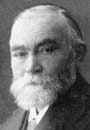
Friedrich Ludwig Gottlob Frege
Gottlob Frege (b. 1848, d. 1925) was a German mathematician,
logician, and philosopher who worked at the University of Jena. He
wrote philosophical works about logic, mathematics, and language.
Principal Works
- Begriffsschrift (‘Concept Notation’), eine der
arithmetischen nachgebildete Formelsprache des reinen Denkens ,
Halle a. S., 1879
- Die Grundlagen der Arithmetik (“The Foundations of
Arithmetic”): eine logisch-mathematische Untersuchung über den
Begriff der Zahl, Breslau, 1884
- Funktion und Begriff (“Function and Concept”):
Vortrag, gehalten in der Sitzung vom 9. Januar 1891 der Jenaischen
Gesellschaft für Medizin und Naturwissenschaft, Jena, 1891
- “Über Sinn und Bedeutung” (“On Sense and Denotation”), in
Zeitschrift für Philosophie und philosophische Kritik, C
(1892): 25–50
- “Über Begriff und Gegenstand” (“On Concept and Object”), in
Vierteljahresschrift für wissenschaftliche Philosophie, XVI
(1892): 192–205
- Grundgesetze der Arithmetik (“Basic Laws of
Arithmetic”), Jena: Verlag Hermann Pohle, Band I (1893), Band II (1903)
- “Was ist eine Funktion?” (“What is a Function?”), in
Festschrift Ludwig Boltzmann gewidmet zum sechzigsten Geburtstage,
20. Februar 1904, S. Meyer (ed.), Leipzig, 1904, pp. 656–666
- “Der Gedanke” (“The Thought”). Eine logische Untersuchung”, in
Beiträge zur Philosophie des deutschen Idealismus I (1918):
58–77
Frege’s Life
- Born, November 8, 1848, in Wismar (Mecklenburg-Schwerin)
- 1869, entered the University of Jena
- 1871, entered the University of Göttingen
- 1873, Ph. D. in Mathematics (Geometry), University of Göttingen
- 1874, Habilitation in Mathematics, University of Jena
- 1874, Privatdozent, University of Jena
- 1879, Professor Extraordinarius, University of Jena
- 1896–1917, ordenlicher Honorarprofessor, University of Jena
- Died, July 26, 1925, in Bad Kleinen (now in Mecklenburg-Vorpommern)
Frege’s Advances in Logic
Frege virtually founded the modern discipline of mathematical logic.
He developed a system of conceptual notation (inspired by
Leibniz’s conception of a rational calculus), and though we no
longer use his notation, his system constituted the first predicate
calculus. Frege’s second-order predicate calculus was based on
the ‘function-argument’ analysis of propositions and it
freed logicians from the limitations of the
‘subject-predicate’ analysis of Aristotelian logic.
Frege’s formal system made it possible for logicians to develop
a strict definition of a proof. Unfortunately, Frege employed a
principle (Basic Law V) in his later system (Grundgesetze)
which turned out to be inconsistent. Despite the fact that a
contradiction invalidated his system, Frege validly derived the Peano
Axioms governing the natural numbers from a powerful and consistent
principle now known as Hume’s Principle (some philosophers have
proposed that the derivation of the Peano Axioms from Hume’s
Principle should be called ‘Frege’s Theorem’).
Frege is most well-known among philosophers, however, for suggesting
that the expressions of language have both a sense and a denotation
(i.e., that at least two semantic relations are required to explain
the significance of linguistic expressions). This seminal idea in the
philosophy of language has inspired research in the field for over a
century.
Further Reading
General
- Currie, G., Frege: An Introduction to His Philosophy,
Sussex, The Harvester Press (Totowa, NJ: Barnes and Noble), 1982
- Dummett, M., “Gottlob Frege”, in Encyclopedia of
Philosophy (Volume 3), New York: MacMillan, 1967
- Zalta, E.,
“Gottlob Frege”,
in
Stanford Encyclopedia of Philosophy
- Zalta, E.,
“Frege’s Theorem and Foundations for Arithmetic”, in
Stanford Encyclopedia of Philosophy
Specific
- Anderson, David, and E. Zalta,
“Frege, Boolos, and Logical
Objects”,
Journal of Philosophical Logic, 33(1)
(February 2004): 1–26
- Boolos, G., “Saving Frege From
Contradiction”, Proceedings of the Aristotelian Society,
87 (1986/87): 137–151
- Boolos, G., “The Consistency of
Frege’s Foundations of Arithmetic”, in J. Thomson
(ed.), On Being and Saying, Cambridge, MA: The MIT Press, 1987,
pp. 3–20
- Demopoulos, W., (ed.), Frege’s Philosophy of
Mathematics, Cambridge, MA: Harvard University Press, 1995
- Heck, R., “The Development of Arithmetic in Frege’s
Grundgesetze Der Arithmetik”, Journal of Symbolic Logic,
58(2) (June 1993): 579–601
- Nodelman, U., and E. Zalta, “Number Theory and Infinity
Without Mathematics”, Journal of Philosophical Logic,
53 (2024): 1161–1197.
https://doi.org/10.1007/s10992-024-09762-7
- Parsons, T., “On the Consistency of the the First-Order
Portion of Frege’s Logical System”, Notre Dame Journal
of Formal Logic 28(1) (January 1987): 161–168
- Resnik, M., Frege and the Philosophy of Mathematics,
Ithaca, NY: Cornell University Press, 1980
- Sluga, H., Gottlob Frege, London: Routledge and Kegan
Paul, 1980
- Wright, C., Frege’s Conception of Numbers as
Objects, Aberdeen: Aberdeen University Press, 1983
- Zalta, E., “Natural
Numbers and Natural Cardinals as Abstract Objects: A Partial
Reconstruction of Frege’s Grundgesetze in Object
Theory”,
Journal of Philosophical Logic, 28(6) (1999): 619–660
Copyright © 2026, by Edward N. Zalta. All rights reserved.